Neither are the souls of the pious dead separated from the Church which even now is the kingdom of Christ. Otherwise there would be no remembrance of them at the altar of God in the communication of the Body of Christ. -- Saint Augustine of Hippo from “The City of God

Please Note

Whenever you use the links on my blog's to make purchases, such as from Mystic Monk Coffee, CCleaner, and others, I earn a small commission. This commission does not have any effect on your costs.

Wednesday, January 25, 2006

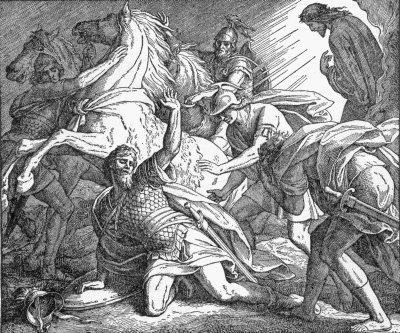
The Conversion of Saint Paul


The Golden Legend
The Conversion of Saint Paul

Of the Conversion of Saint Paul and of the name of conversion.
Conversion is said of convertor, I am turned, or is as much as together turned from sins and evils. He is not converted that shriveth him to the priest of one sin and hideth another. It is said conversion, for Saint Paul this day was converted to the faith leaving his vices. Why he is said Paul, it shall be said afterward.
Of the Conversion of Saint Paul.
The conversion of Saint Paul was made the same year that Christ suffered his passion, and Saint Stephen was stoned also, not in the year natural, but appearing. For our Lord suffered death the eighth calends of April, and Saint Stephen suffered death the same year, the third day of August and was stoned. And Saint Paul was converted the eighth calends of February. And three reasons been assigned wherefore the conversion of Saint Paul is hallowed more than of other saints.
First for the ensample, because that no sinner, whatsomever he be, should despair of pardon when he seeth him that was in so great sin to be in so great joy. Secondly for the joy, for like as the church had great sorrow in this persecution, so had she great joy in his conversion. Thirdly, for the miracle that our Lord showed when of one so cruel a persecutor was made so true a preacher. The conversion of him was marvellous by reason of him that made him, and of him that ordained him, and of the patient that suffered it. By reason of him that made him to be converted, that was Jesu Christ, which showed there his marvellous puissance in that he said: It is hard for thee to strive against the alle or pricks; and in that he changed him so suddenly, for anon as he was changed he said: Lord what wilt thou that I do? Upon this word saith Saint Austin: The lambs slain of the wolves have made of a wolf a lamb, for he was ready for to obey, that tofore was wood for to persecute. Secondly, he showed his marvellous wisdom. His marvellous wisdom was in that he took from him the swelling of pride in offering to him the inward things of humility and not the height of majesty. For he said I am Jesus of Nazareth, and he called not himself God ne the son of God, but he said to him, take thine infirmities of humanity and cast away the squames of pride. Thirdly, he showed his pitiful debonairty and mercy, which is signified in that that he that was in deed and in will to persecute, he converted, how be it he had evil will, as he that desired all the menaces and threatenings, and had evil purpose; as he that went to the prince of priests; as he that had a joy in his evil works that he led the christian men bound to Jerusalem. And therefore his journey and voyage was right evil, and yet nevertheless by the mercy of God was he converted. Secondly the conversion was marvellous of him that ordained it, that is of the light that he ordained in his conversion. And it is said that this light was dispositive, sudden, and celestial, and this light of heaven advironed him suddenly. Paul had in him these vices. The first was hardiness, which is noted when it is said that he went to the prince of the priests, and as the gloss saith, not called, but by his own will and envy that enticed him. The second was pride, and that is signified by that he desired and sighed the menaces and threatenings. The third was the intent carnal, and the understanding that he had in the law, whereof the gloss saith upon that word: I am Jesus, etc. I God of heaven speak, the which thou supposest to be dead by the consent of the Jews. And this light divine was sudden, it was great, and out of measure, for to throw down him that was high and proud, into the ditch or pit of humanity; it was celestial, because it turned and changed his fleshly understanding into celestial, or it may be said that this ordinance or disposition was in three things; that is to wit in the voice crying, in the light shining, and in the virtue of puissance. Thirdly, it was marvellous by the virtue of the suffering of the patient, that is of Paul in whom the conversion was made. For these three things were made in him withoutforth marvellously, that it is to wit, that he was beaten to the earth, he was blind and fasted three days, and was smitten down to the ground for to be raised. And Saint Austin saith that he was smitten down for to be blind, for to be changed, and for to be sent; he was sent to suffer death for truth. And yet saith Saint Austin, he that was out of the faith was hurt for to be made believe, the persecutor was hurt for to be made a preacher, the son of perdition was hurt for to be made the vessel of election, and was made blind for to be illumined, and this was as touching his dark understanding.
Then in the three days that he abode thus blind, he was learned and informed in the gospel, for he learned it never of man ne by man, as he himself witnesseth, but by the revelation of Jesu Christ. And Saint Austin saith thus: I say that Saint Paul was the very champion of Jesu Christ, taught of him, redressed of him, crucified with him, and glorious in him. He was made lean in his flesh that his flesh should be disposed to the effect of good operation, and from forthon his body was established and disposed to all good. He could well suffer hunger and abundance, and was informed and instructed in all things, and all adversities he gladly suffered. Chrysostom saith: He overcame tormentors, tyrants, and people full of woodness, like as flies; and the death, the torments and all the pains that might be done to him, he counted them but as the play of children. All them he embraced with a good will, and he was ennobled in himself to be bound in a strong chain more than to be crowned with a crown, and received more gladly strokes and wounds than other gifts. And it is read that in him were three things against the three that were in our foremost father Adam, for Adam erected and addressed him against God our Lord. and in Saint Paul was contrary for he was thrown down to the earth. In Adam was the opening of his eyes, and Paul was on the contrary made blind, and Adam ate of the fruit defended, and Saint Paul contrary was abstinent of convenable meat.
Acts 9:1-22
In those days: Saul as yet breathing out threatenings and slaughter against the disciples of the Lord, went to the high priest, and asked of him letters to Damascus, to the synagogues, that if he found any men and women of this way, he might bring them bound to Jerusalem. And as he went on his journey, it came to pass that he drew nigh to Damascus; and suddenly a light from heaven shined round about him. And falling on the ground, he heard a voice saying to him: Saul, Saul, why persecutest thou Me? Who said: Who art Thou, Lord? And He said: I am Jesus Whom thou persecutest. It is hard for thee to kick against the goad. And he trembling and astonished, said: Lord, what wilt Thou have me to do? And the Lord said to him: Arise, and go into the city, and there it shall be told thee what thou must do. Now the men who went in company with him stood amazed, hearing indeed a voice, but seeing no man. And Saul arose from the ground, and when his eyes were opened, he saw nothing. But they leading him by the hands, brought him to Damascus. And he was there three days without sight, and he did neither eat nor drink. Now there was a certain disciple at Damascus, named Ananias; and the Lord said to him in a vision: Ananias. And he said: Behold I am here, Lord. And the Lord said to him: Arise, and go into the street that is called Strait, and seek in the house of Judas, one named Saul of Tarsus. For behold he prayeth. (And he saw a man named Ananias, coming in and putting his hands upon him, that he might receive his sight.) But Ananias answered: Lord, I have heard by many of this man, how much evil he hath done to Thy saints in Jerusalem. And here he hath authority from the chief priests, to bind all that invoke Thy name. And the Lord said to him: Go thy way, for this man is to Me a vessel of election, to carry My name before the gentiles, and kings, and the children of Israel. For I will show him how great things he must suffer for My name's sake. And Ananias went his way, and entered into the house, and laying his hands upon him, he said: Brother Saul, the Lord Jesus hath sent me, He that appeared to thee in the way as thou camest, that thou mayst receive thy sight, and be filled with the Holy Ghost. And immediately there fell from his eyes as it were scales, and he received his sight and rising up he was baptized. And when he had taken meat he was strengthened. And he was with the disciples that were at Damascus for some days. And immediately he preached Jesus in the synagogues, that He is the Son of God. And all that heard him were astonished, and said: Is not this he who persecuted in Jerusalem those that called upon this name; and came hither for that intent, that he might carry them bound to the chief priests? But Saul increased much more in strength, and confounded the Jews who dwelt at Damascus, affirming that this is the Christ.
Copyright © 2006 Steve Smith. All rights reserved.

Aquinas and More Catholic Goods - For all your Catholic needs

Saint Paul the Apostle

Saint Paul the Apostle

Tuesday, January 24, 2006

Blessed James Alberione


James Alberione may not be universally well known, yet many of us read great books on the Faith which we have purchased from the Pauline bookshops. Father James had such a great love for our Catholic Faith that he wished to share it with as many people as possible, but first let us start from the beginning.

James Alberione was born into a family of poor farmers in the year 1884 in Italy, his parents, Michael and Teresa were deeply devout and raised their children to also live their Faith. With little James though this was not such a hard thing to instill for James from an early age longed to become a Priest and said so when questioned!

Though little James came from hardy peasant stock this did not stop him from going to school as both his parents placed great emphasis on learning and gaining a good education. Both Michael and Teresa taught their children a love of knowledge with an equal amount of love for God, for to gain knowledge without putting it to good use would be inexcusable!

The Alberione family eventually moved to Cherasco, parish of San Martino in the diocese of Alba, where James came to the notice of Father Montersino, who encouraged James to follow his calling from God. And under the gentle guidance of this Priest, James truly shone as he learnt the fundamentals and also the deeper theology of the Catholic Faith. And at the young age of only 16 years, James entered the Seminary, where he met another Priest, Canon Francesco Chiesa, who became to him not only a mentor but a friend, guide and instructor to the intricacies of the Catholic Church.

But it was a night spent in prayer before the Blessed Sacrament that would lead James to become more than an ordinary Priest as he felt God call to him to pursue an avenue of evangelisation to the young people of the new Century! Upon completing his studies James Alberione was Ordained a Priest in 1907, he spent a brief spell in Narzole as an assistant Pastor but it was here that he also began to reflect on women’s role within the Church structure, this thought would stay with him for many years.

During these years of guiding young seminarians as their spiritual director and also of teaching Catechesis to the young people, it began to dawn on Fr. James that a new Era called for a better way of communicating the Faith to all people around the world. It was at this time also that he authored two books one in particular touched his heart and dealt with women and how their gifts could benefit the Church.

And it was during this time that Father James felt called to orchestrate a new Order to be undertaken by Consecrated souls in order to spread the Gospel to the four corners of the earth, a noble thought indeed! This Order would at first be termed the Pious Society of St. Paul, which would be better known as the 'Pauline Family' of Brothers and Sisters, when Father James began and incorporated the 'Daughters of St Paul', with the help of a young woman Teresa Merlo who had also embraced his ideal of spreading the Gospel message.

For both Father James and Teresa realised that they were living in an era where the technology of communication was ever growing and expanding into new formats, they both wished to seize the day for Gods Glory. But this dream nearly faltered when Father James Alberione became seriously ill and little hope was held for a recovery. But upon recovering he credited his healing to St. Paul, for he while he was sick he had seen in a dream these words, "Do not be afraid. I am with you. From here I want to enlighten. Be sorry for sin." Father James took this as his living Motto and for his Order of the Pauline Family.

This also led him to enlarge his family to include the prayerful apostolate of 'the Pious Disciples of the Divine Master', which was a group of Sisters who would dedicate their lives to prayer and Eucharistic Adoration. He chose Sr. Scholastica Rivata to join him in this prayerful addition to the Pauline family, for both of these holy souls realised that prayer was essential for the lifeblood of their Order.

During this time Father James and his merry band of Pauline Brothers and Sisters began many enterprises, they started a serious of periodicals which explained the Faith and also printed editions of the Holy Bible which they sent to all parts of the world. A small magazine was also begun for Parish Priests called 'The Pastoral Life' to encourage Priests in their Vocation and Pastoral duties. Once again in 1931 he instituted another magazine called 'Christian Home' for families to read and learn at home, and to inculcate a love of the Faith within the family unit.

This was just the beginning of Father James Alberiones dream of reaching people even in the most inhospitable conditions and to reach out to those in countries who were impoverished and needed the guiding light of the Church to give them hope in a harsh landscape.

This great man of vision seemed to have no hindrances placed before him as he continued his mission to reach into as many families as possible via the media even unto continuing through the war years, which allowed him some time to reflect on the way ahead for his Pauline Family. His dedication to the cause of spreading the Good News both near and far, never wavered as he began new Orders and kept a pastoral albeit loving eye on his already growing Pauline Family of Media and Publishing endeavours.

No one could have envisioned this young boy who had exclaimed to his teacher when asked ' I will be a Priest', would come to influence so many people in vastly different lands of all walk and all colours as he spread the Gospel message of Jesus Christ and the love of our Catholic Church and its Teachings.

There are now thousands of Pauline bookshops around the globe, helping to instruct the Faithful and those wishing to learn the Faith. All of which came from his vision and passion that has blazed a trail for future enterprises as many look at the life of this remarkable Saint and learn to emulate his philosophy of perseverance and giving all Glory to God.

Father James Alberione died in 1971.

Blessed James Alberione was beatified in 2003 by Pope John Paul II.

Peace of Christ to ALL

Copyright © 2006 Marie Smith. All rights reserved.

Tuesday, January 17, 2006

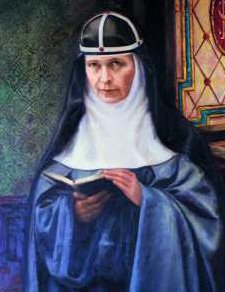
Blessed Elizabeth Hesselblad


Elizabeth Hesselblad was born in the year 1870, into what would become a very large family of thirteen siblings, even though not all the children survived into adulthood. Still her parents struggled to maintain such a large family and both parents were diligent in the upbringing of their children.

Elizabeth's parents, Auguste and Karin Hesselblad, though caring for their large brood, struggled to make ends meet as they tried running a grocery shop before embarking on opening a bookshop, which barely helped them make ends meet.

Being that Sweden's major religion was Lutheran, so Auguste and Karin raised their children, with a deep Faith in God and a love for the Word of God, as they attended Lutheran services every week almost without fail. It was this faith in God that helped the family persevere through many adversities including the loss of three children at a young age.

Elizabeth would have noted her parent’s strictness and vigilance concerning God and their faith and also the work ethic which both parents tried instill in all their children. But these were also the days before penicillin was discovered so Elizabeth was open to many infections and deadly illnesses, and it was at age 7 that she became very ill with diphtheria and scarlet fever. And though the young Elizabeth recovered from these deadly bouts her health remained fragile all her life as she suffered with stomach ulcers and hemorrhages.

This battle for her health probably also helped to make Elizabeth a little more introspective than her brothers and sisters and also made her realise that life was an adventure and to treasure each moment.

And it was this sense of adventure that led Elizabeth to seek out employment in America in order to help provide for her family but also to gain some monetary security for herself. So it was that in 1888 Elizabeth arrived in New York, to a very different land than that of Sweden. She would have noticed the vibrancy and freshness of this new land and also its diversity as different people migrated to the land of the free.

But Elizabeth was sturdy and stoic by nature, but also with a compassionate heart she sought to work amongst the sick and injured, and so she studied nursing as a way of expressing her love of God and to earn some much needed money.

It was through nursing that Elizabeth's spiritual journey would begin as she came into contact with many Irish and Italian working class people who sought out medical attention. The Faith in God that these patients showed and their great love of the Catholic Church shone through these poor but devout people. This would engage Elizabeth in her own personal struggle to understand just what Catholicism meant and how to encompass it in her own life.

And it was at moments when in need of a break that Elizabeth would wander into Catholic Churches to restore her spirit and energy, it was also here that Elizabeth experienced God in a meaningful way. But it was the Corpus Christi procession when upon seeing the Blessed Sacrament, Elizabeth heard an interior voice speak in the depths of her soul with these words, 'I am the One you seek.'

This confused Elizabeth for though the Lutherans had a great love of God and Scripture she had never heard of experiences such as this, for God had touched this young woman's heart and sought her for Himself. And the more Elizabeth learnt the more she became convinced that God was calling her to enter the Catholic Church. One of the things that truly touched a chord in Elizabeth’s heart was the love many Catholics had for the Blessed Mother, this too would help move Elizabeth to leave her Lutheran roots and convert to the One True Church.

So it was that in 1902, Elizabeth was given a conditional baptism into the Catholic fold and it was also in 1902 that Elizabeth returned to Europe on a pilgrimage to Rome whereupon she received the Sacrament of Confirmation. It was also during this time that Elizabeth felt a calling to enter the Religious life and most especially to embrace the spirit of St. Bridget of Sweden.

But Elizabeth needed to take her first steps in the spiritual life which she did so under the guidance of Mother Hedwig who though she had concerns about the health of this devout woman, still encouraged her to seek God in prayer and the service of others. It was here at the Carmelite community of Saint Bridget that Elizabeth became more convinced to follow in the footsteps of her beloved hero St. Bridget.

And so in 1906 her wish to enter the Religious life was granted and Pope Pius X approved her taking the Habit of the Order of the Most Holy Saviour of Saint Bridget.

The love Elizabeth had for this great Saint was so intense that nothing could prevent her from trying her utmost to revive this great and noble Religious Order. And though she faced many disappointments in her attempts still her heart was replenished when in 1911 she was joined by three English women.

Through many hardships and disappointments Elizabeth never lost sight of her mission and in 1931 she received the Vatican's approval to live and work at the house of Saint Bridget in Rome, where she was made Mother Superior. And through her hard work this Order would reach out to many countries including India.

Elizabeth also during the years of the second world war, helped those who were being persecuted under Nazi tyranny, as she helped clothe and feed the hungry and terrified refugees, this was done at the risk of her own life and her Sisters.

During all this activity though Mother Elizabeth continued to pray for a reconciliation of the many diverse religious denominations, in the hope that others too would return to the Catholic fold and experience the joy in which she had.

She was to maintain this hope of religious reconciliation for the rest of her life.

Elizabeth Hesselblad died in 1957.

Blessed Mary Elizabeth Hesselblad was beatified in the year 2000 by Pope John Paul II.

Some Quotes

"The Lord has called us from different nations, but we must be united with one heart and one soul. In the divine Heart of Jesus we will always meet one another and there we seek our strength to face the difficulties of life. May we be strengthened to practice the beautiful virtues of charity, humility and patience. Then our religious life will be the antechamber to Heaven."

"Our religious houses must be formed after the example of Nazareth: prayer, work, sacrifice. The human heart can aspire to nothing greater."

"Dear Lord, I do not ask to see the path. In darkness, in anguish and in fear, I will hang on tightly to your hand and I will close my eyes, so that you know how much trust I place in you, Spouse of my soul."

Peace of Christ to you ALL

Copyright © 2006 Marie Smith. All rights reserved.