Neither are the souls of the pious dead separated from the Church which even now is the kingdom of Christ. Otherwise there would be no remembrance of them at the altar of God in the communication of the Body of Christ. -- Saint Augustine of Hippo from “The City of God

Please Note

Whenever you use the links on my blog's to make purchases, such as from Mystic Monk Coffee, CCleaner, and others, I earn a small commission. This commission does not have any effect on your costs.

Thursday, January 12, 2006

Saint Margaret Clitherow


At a time of great peril in Tudor England, where being a Catholic could be a death sentence, one woman's courage stands above the crowds.

For though Margaret Clitherow was not born a Catholic, upon marrying her husband John, she converted to Catholicism three years later. The surprising aspect is that her husband, though born a Catholic, recanted his own Faith, and instead embraced the State Religion of England.

Being that the Church of England was still in its infancy, this led Elizabeth I to take decisive action against anything that would challenge her position as head of the Church. This insecurity would show itself in the persecution of Catholics under the reigns of both King Henry the VIII and Elizabeth I!

But Margaret Clitherow was not any ordinary person and upon her acceptance into the Catholic Church, she embraced all its teachings and also practiced the corporal works of mercy. And though her husband did not join her in reverting back to his Catholic roots, he also did not impede Margaret’s transition to the Catholic fold. John Clitherow also did not stand in the way of their children also embracing the Catholic Church.

Margaret was indeed a woman of uncommon valour, who not only practiced her beliefs, but attempted with a zealous spirit to evangelise the Faith in Protestant England. But due to Margaret’s gentle, compassionate and loving nature many were drawn to her spirit and longed to also have this happiness within themselves. This woman found herself in the position of being loved and respected by people of both Faiths, a fact that those in authority found troublesome.

This courageous woman would also allow Mass to be said in her home at grave risk of her life, and those who attended Mass with her, for under Elizabeth I attending Mass had become a criminal offence. But nothing was going to stand in the way of Margaret’s passionate love of God and the Catholic Church, as she hid Priests in secret hiding places in her home.

And with the full support of her husband, Margaret also sent some of her children to France, so they could receive a Catholic education untainted by Protestant teachings.

Margaret was of a resolute nature, a trait shared by many Yorkshire people. And her stubbornness in spreading the Faith could not be stopped as Margaret longed for all the peoples of her country to return to the Faith of their forebears and once again embrace their Catholic roots.

And though Margaret had no fear of Queen Elizabeth I, the same could not be said of the Queen. Who, like her father before her had set upon a course of persecuting those who refused to leave the one true Faith, Catholicism.

But through all this strife Margaret kept her composure and loved all people as children of the one God. This was a singular trait in that though Margaret suffered persecution, still she offered the same courtesy to all she met irrespective of their Faith.

Through Margaret’s respect for others and her inherent dignity, she touched all the hearts of those she met. This love for her Faith and her longing to share it with others would lead her down the path of martyrdom, but Margaret persevered to the end with a fierceness that can only be admired by one and all.

And though Margaret's Faith strengthened her, as she kept a vibrant prayer life even amidst perilous danger, it was this that enabled her to hide Priests in order to participate in the Sacraments of the Church, this level of personal courage and conviction left deep imprints on her own children.

Her sons would become Priests and her daughter entered the Religious life. Margaret’s children are surely a testament to her as a person of immense fortitude and perseverance, as well as a loving wife and mother. And as in life, Margaret died with courage as she was tortured for her Faith and love of the one true Church.

Margaret Clitherow died in 1586.

Saint Margaret Clitherow was canonized in 1970 by Pope Paul VI.

Some Quotes

"by God's grace all priests shall be more welcome to me than ever they were, and I will do what I can to set forward God's Catholic service."

"Having made no offense, I need no trial."

"Jesu, Jesu, Jesu, have mercy on me!"

Peace of Christ to All

Copyright © 2006 Marie Smith. All rights reserved.

St. Margaret Clitherow

Sunday, January 08, 2006

Saint Thomas Becket


Thomas Becket during his life time would be friends of Kings and commoners alike, but always at the centre of his heart, was his Faith.

Thomas was born into a prominent family who were able to send him to the better schools of the time, this would help Thomas in later life as his career grew.

Thomas by all accounts was a very personable young man, who was outgoing and enjoyed sport and good conversation, Being that he was very able at speaking and communicating his ideas, he decided quite young to serve the Church, he then studied for a period of time at Merton Abbey before moving on and studying in France.

But upon completing his studies he returned home to bad news in that both his parents had died during his absence, this grieved Thomas as he grappled with his loss and his future. It was at this difficult time that Thomas found employment as a clerk, this would be the beginning of great things for Thomas.

While working as a clerk Thomas gained a reputation for hard work and a sense of excellence in all he undertook. This led him to be noticed and offered a job working for the Archbishop of Canterbury; Theobald was impressed with Thomas grasp of complicated issues. And while working for Archbishop Theobald, Thomas then decided on a vocation and with the permission of the Archbishop Thomas began studying Canon Law in both Italy and France. Thomas found that study suited him and his more serious side, for though Thomas was known for his easy going nature, still there was also the more contemplative aspects to this man of vision and ambition.

Upon completing his studies Thomas returned to England and was made provost of Beverley and also canon at St. Paul’s cathedral. And it was in 1154 that Thomas was ordained a Deacon whereupon Archbishop Theobald upon hearing of Thomas valuable gifts soon decided to appoint him as archdeacon of Canterbury, a high honour indeed!

Thomas was to prove himself a great credit to the Archbishop for his ability to listen and to master the art of diplomacy, in that Thomas was not only well learned he also possessed the personality to make others feel important and more learned than himself. And it was through Thomas's intervention that Pope Eugenius III did not recognise Stephen's claim to the throne but instead Henry Anjou would become King Henry II.

The King had noted Thomas's intervention and was very favourable to this man who had great skills in the very difficult field of diplomacy. And through King Henry II, Thomas was appointed as chief minister. The King came to appreciate Thomas humour and also his keen intellect, as both became friends, and admirers of each others qualities.

This friendship would prove profitable to the English people as Thomas encouraged the King to make much needed reforms when it came to protecting the rights of the poor in a court of law. For Thomas had a keen sense of justice and wished all to receive the assistance needed to overcome misfortune.

But Thomas was no ascetic as he surrounded himself with the finer things in life, and lived in some splendour. He was also able to maintain a very resplendent and palatial home with numerous servants. But this attitude suited King Henry II as he turned more and more to Thomas for companionship and high living. But Thomas did not confine his largesse to himself but shared some of his wealth with the poor and others in need of his help.

The friendship between Thomas and the King was also based on mutual respect and also at times disagreements, as both Thomas and King Henry II were free to correct one another, and did so! But beyond Thomas carefree ways also lay a man of steel, who at times hid this strength of character, but when he felt the King had done wrong, then Thomas was not above cautioning even rebuking his Sovereign!

Things were to change though when Archbishop Theobald died and King Henry II wished to replace him with his friend Thomas, as to this request, Thomas himself was unsure as he did not wish to incur the full wrath of the King. For though Thomas admired the King he was also not blind to his faults but rather he was very much aware of them and that as Archbishop of Canterbury it would be the job of Thomas to stop the Kings excesses.

But the Kings request won the day and after promptings from Cardinal Henry of Pisa, Thomas agreed to become the Archbishop of Canterbury. But Thomas still held deep misgivings for through his close friendship with the King he also knew of the Kings darker side and ferocious temper. So it came to pass that in 1162 Thomas was elected Archbishop, and later he would receive the pallium of Pope Alexander III.

Thomas would take this role seriously and so his luxurious lifestyle became a thing of the past as he practiced penances and mortifications. Thomas spent the next few years visiting the infirm, teaching Scripture and promoting the Religious life. And as Thomas gained confidence in his job he also grew in his Faith as he looked more and more to God to guide him in all his decisions.

The King at first accepted the change within his friend, but the tide would soon turn against Thomas as the King began to resent Thomas sincere Piety. This would lead to severe discord between the two as different issues were raised which brought forth an irretrievable break in their friendship.

This happened when King Henry II wished to prosecute a canon who was accused of murder, but the King wished to oppose the law of the land and instead of leaving the judgment and ruling to an ecclesiastical court, the King decided to try and take matters in his own Regal hands! This would bring the King and Thomas to a direct confrontation, as Thomas insisted that the canon had already been found not guilty of the crime. This incensed the King who felt that Thomas had opposed in a deliberate and flagrant way his own Sovereign power.

In a last ditch effort to salvage his friendship with the King Thomas as Archbishop of Canterbury crossed the channel to see the Pope, but this act would prove to be futile as the Kings rage grew by the hour and plans were already afoot to remove Thomas as Archbishop!

The King decided on a plan of humiliating Thomas by discrediting him and taking his properties from him, and though once again Thomas tried to placate the Kings fury it would prove futile, as every attempt was rejected.

But things could not go on like this and so the confrontation came to a head as the Earl of Leicester brought a message to Thomas that the King had demanded a look into his accounts so that the King himself would be sole judge of Thomas and not the Pope! Upon hearing this Thomas exclaimed, "Judgment?" "I was given the church of Canterbury free from temporal obligations. I am therefore not liable and will not plead with regard to them. Neither law nor reason allows children to judge and condemn their fathers. Wherefore I refuse the King's judgment and yours and everyone's. Under God, I will be judged by the Pope alone."

Thomas as Archbishop once again set out to see the Pope and upon explaining his position Thomas then resigned but the Pope upon consideration reinstated Thomas and sent him to a Cistercian Monastery. Upon arriving Thomas dressed in the habit of the monk's who lived there. But this was not the end as the King in his fury took out his vengeance on Thomas's relations and friends for there was no end to King Henry's II malice!

Though Thomas spent a few years in France, he was required to return to England but Thomas knew in his heart that his days were now numbered. And so Thomas once again touched the shorelines of Great Britain, and awaited his fate.

And it would be the Kings words uttered in the heat of the moment that sealed Thomas fate for once again this man of Faith stood firm against the Kings wishes to reinstate and absolve the Bishops who had supported the Kings stance against Thomas. Upon hearing of Thomas strong stand the King muttered to those near him, "What sluggards, what cowards have I brought up in my court, who care nothing for their allegiance to their lord. Who will rid me of this meddlesome priest."

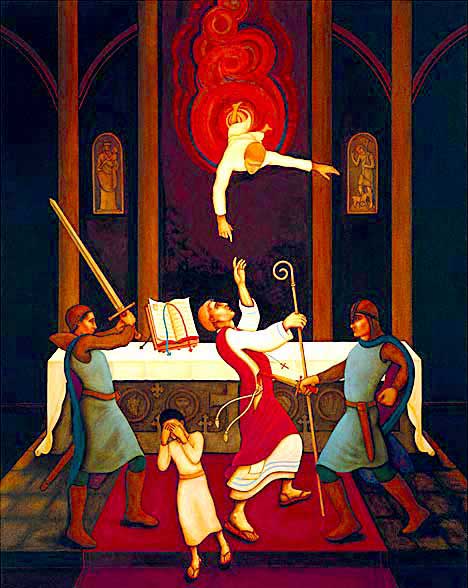
It was then that a group of knights decided to murder Archbishop Thomas Becket and so they did while Thomas was celebrating Mass, these heathens hacked Thomas Becket to death by splitting his skull.

Thomas Becket found out with his life that to befriend a King was a risky business indeed, as one who came later also discovered this to be true.

Archbishop Thomas Becket died in 1170.

Saint Thomas Becket was canonized in 1173 by Pope Alexander III.

Peace of Christ to ALL

Copyright © 2006 Marie Smith. All rights reserved.

Wednesday, January 04, 2006

Blessed Kateri Tekakwitha


Little Kateri's life started out well enough in that she was the daughter of a Mohawk Chief and a Catholic Algonquin mother. And it would be at her mothers knees that little Kateri would listen to her soothing prayers to a man named Jesus and saw for herself the peace that lay within her mothers heart. And from both her father and mother little kateri learnt to love and respect nature as a provider and also a nurturer.

But Kateri's family life was cut short when an epidemic of small pox raged through her village near Auriesville New York in 1660. Kateri was lucky to have survived this disease and was left scarred and visually impaired through this dreaded illness. Little Kateri found herself orphaned at the early age of only four years old, she was soon adopted by an uncle who was also a Mohawk Chief.

Things worked out well enough for a while for the little Kateri as she blossomed under the care of her Uncle and Aunts and took part in village life as she helped tended the fields and other chores to help provide for their livelihood. But Kateri never lost the memory of her gentle mother and the soothing prayers her mother would whisper at night.

And many times Kateri would wander out into the forest to whisper her own thoughts to this land that she loved so well. Through her vision impairment, Kateri became more sensitive and intuitive to her surroundings and could sense things more clearly as her other sensed were honed to compensate for her loss of clear vision. This also allowed her gentle and sweet nature to shine for all to see as she also came close to a longing for the peace that she remembered in her mothers short life, and reflected on the stories of the Catholic Faith her mother shared with her at night when Kateri would prepare for sleep.

Kateri longed to know of this God who was gentle and mild and in mother nature she could sense the Presence of God all around her. She would hear the whisper of God's voice in the breeze and smell the beauty of His Presence in the wild flowers and earthy ground as she stepped on the fallen leaves. But it was in her inner heart that she could sense a stirring that owed nothing to the wind or scents that were wafting in the breeze, instead she sensed an inner calling of a Father to His child a longing to be closer to the Eternal Presence of the Almighty.

Though Kateri could sense all these things she kept these thoughts hidden in her heart of hearts for many years and continued to live with her adopted family and partake in the chores and share in the village life of those who supported themselves from the land of their birth.

But it was a visit from a Priest that would change Kateri's life, and though her uncle disapproved of these Missionaries he did allow Fr. de Lamberville to set up a mission in his area. When upon meeting the missionary Father de Lamberville, fond memories of her mothers faith came back and Kateri's heart searched for this love of God that had been hidden within for many years.

Upon consulting with her Uncle, Kateri was given permission to learn about the Catholic Faith and its beliefs, her uncle would come to regret this decision when at at age 20 Kateri was baptized into the Catholic Church. And it was here that the name Kateri was given her which means Catherine in English.

But the conversion of Kateri would cause major disruption and outright ridicule from her nearest relatives as they refused to acknowledge Kateri's baptism into the Catholic Faith. This led to outright condemnation and persecution when Kateri refused to work on Sundays, so due to this her Uncle and Aunts refused to give Kateri any food on that day. Things would get worse as Kateri found herself suffering the taunts of little one's and with threats of torture if she did not renounce her new Faith.

This persecution led Kateri to leave the village and her people whom she loved so dearly, but her love for God was greater. So came a mammoth journey as this vision impaired woman walked a staggering 200 miles through unmanageable land and rough terrain so she could reach the safety of the Mission of St. Francis Xavier near Montreal Canada. We must also remember that this courageous young woman wore only the basics in shoe covering could carry no supplies for her journey and all this through all manner of weather.

Because of the courage that Kateri had shown when she fled her village rather than give up her Faith, she was allowed to receive her First Holy Communion on Christmas day in 1677. This was a momentous day for Kateri as she felt the loving spirit of her mother close to her and that she had finally received her beloved Jesus in the Eucharist.

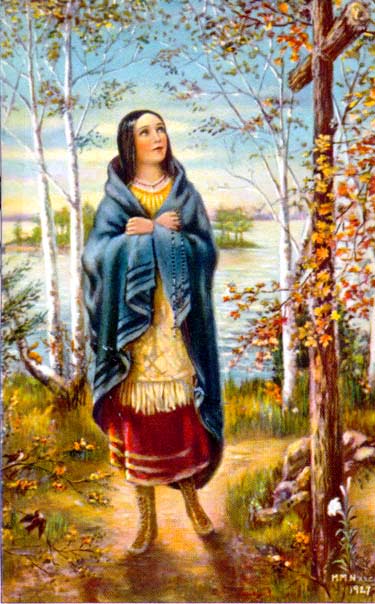
Kateri may have lacked the skills to read and write, still her spiritual life flourished as she embraced a life of prayer and very austere penances. But though Kateri had suffered much, she never lost her peace of heart and remained a serene and loving individual to all who met her. One of Kateri's favourite things to do was to fashion wooden crosses and lay them in the surrounding acres as she prayed the Stations of the Cross.

Prayer became an essential part of Kateri's life and even in the most bitter of winter weather many people would see Kateri kneeling in the snow in freezing conditions praying to God before a Cross she had fashioned out of wood. She also wore a Rosary around her neck in honour of the Blessed Mother whom she loved dearly and embraced as her own mother.

Many people would flock around so they could be in the presence of this wonderful girl, for her love of God shone in her face and in times of bleak austerity Kateri showed what loving God could achieve for the soul, who abandons themselves to Him. She would spend many hours praying before the Blessed Sacrament, her face glowing with an inner light as she very simply loved God and He loved her.

It was while she was at prayer that Kateri promised the Lord to live a life of chastity and devote her whole being to Him as she continued to practice severe mortifications and penances. But even though Kateri was cautioned against too much mortification still she continued this practice.

But due to these penances and the severe winters praying in freezing temperatures, all of this took its toll on Kateri's fragile health. But through the life of Kateri, she showed that God does not ask for great knowledge or lengthy debates on theology, what God asks for is Love and Kateri excelled at loving God and her neighbour.

Kateri Tekakwitha died in 1680.

Blessed Kateri Tekakwitha was beatified in 1980 by Pope John Paul II.

Peace of Christ to ALL

Copyright © 2006 Marie Smith. All rights reserved.