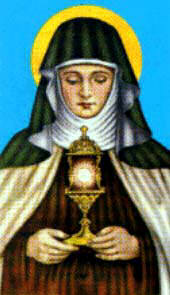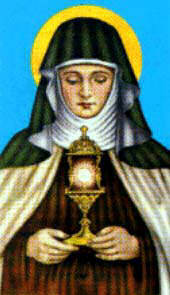
Clare was born into a noble family in the year 1194, they were able to maintain their comfortable living style due to the good business acumen of her father, Favorino Scifi, and the large estates he owned. But this comfortable existence meant little to the young Clare, who learnt her Faith from her very devout mother, Ortolana, who taught Clare at a very young age to pray and place God at the centre of her life.
It was also through observing her mother's actions when practicing the corporal works of mercy which in later life would distinguish Clare from her contemporaries. For unlike many wealthy people, Ortolana treated those who were less well off with due respect and consideration, her daughter Clare would later emulate this care for the poor without demeaning their dignity.
And even though war at times disrupted the family's daily routine it did not lead them to doubt God's Wisdom as the Scifi household accepted all as if it were from the hand of God.
But from early childhood Clare gravitated towards a prayerful encounter with her beloved Jesus and also practiced many penances and mortifications which was considered normal for the age that she lived in. This is not to say that Clare was dour and gloomy, for within Clare lay a glowing light of love for God and for people which shone within her so that many who would come into contact with her felt blessed by this remarkable young lady.
Because Clare was born into the nobility this also meant that she was highly intelligent, eloquent and could correspond with clarity her idea's and thoughts to others in a way that articulated her longing to become closer to her Lord and Saviour Jesus Christ. But though Clare was learned she loved God from her heart with a simplicity that was granted to few.
Clare was also a strong woman who knew her own mind and where her heart was guiding her, and though she had this inner strength it was matched with an equal amount of humility and meekness. And through her correspondence she shared her thoughts on the depths of her spirituality and what it means to love God with all of ones entire being.
And though strong of heart and mind, she was also highly intuitive and embraced her femininity without vanity. For upon Clare's face was always a smile no matter what difficulties she was facing or how many interior trials she was undergoing, Clare kept her sense of self, by acknowledging that all she had came from a loving God, therefore nothing belonged to her, not even her thoughts.
To love God is to mirror His Divinity; Clare did this beautifully as she displayed a love and generosity towards all with a spirit of joy and tranquility. For Clare needed no artifice to impress others, but instead lived to please God.
So through deep prayer Clare sought out what was God's Will when it came to living her life so it was that Francis came into her life at a crucial moment. For like Francis, Clare had a burning desire and a zealous spirit to love God till it costs; she was not a woman for halfway measures. Upon hearing Francis speak at the Cathedral of San Rufino, Clare was deeply impressed and moved to contact this fiery but sensitive man of peace who embraced and lived the fire of God's Majestic love.
It was through seeing Francis and his zealous love for God that was to be the start of Clare's spiritual quest to serve and love God through prayer and service to those in need. And so Clare in great secrecy met Francis in the company of her Aunt and upon hearing her ardent desire to serve God, Francis then accepted this erstwhile young lady into his way of life and spirituality. So in complete humility Clare lay aside all her fine garments and replaced them with worn out rags stitched together to form a habit. And further it was Francis who clipped her beautiful hair as a sign of her obedience and lack of vanity.
Upon taking these actions Clare then went to live with the Benedictines nuns at San Paolo, her she continued to live a life of deep austerity and a continued her prayer life as one beloved of God. But even though Clare's happiness was complete not everyone felt this same joy, for her father objected vigorously to the steps his beautiful daughter had taken and tried to forcibly remove her from the Convent.
But Clare was formidable when it came to matters of Faith and though she loved her father, she loved God more and so she with a gentle but firm heart refused to leave the Mission on which she and Francis had embarked on. And so Clare with great fortitude and determination lived her religious life with gentleness and humility, she would later be joined by her sister, Agnes, and later still by her own very devout mother.
Through all these ordeals Clare never lost her peace of heart nor ever felt discouraged and with real burning passion she tried to emulate the life of our Lord in her own small way. Francis was also busy as he searched for a place for Clare and her small band of companions to set up their own community.
So it was that Francis rebuilt for his religious sisters their own communal Convent at San Damiano, through the generosity of the Benedictines. This was the first steps in Clare's and Francis shared vision of loving God through a life of prayer and poverty, the little Convent they lived in became the Order of Poor Ladies, which in time would be recognised as the 'poor Clares'.
But not all things would work smoothly as both Clare and Francis came up against obstacles in the way their Order would be lived and the spirituality of total poverty met objections in some quarters. At first Clare was obliged to live much as the Benedictines did, but this did not suit Francis nor Clare's vision of their Order.
What Clare objected to most strongly was the idea that her Sisters could acquire and keep some property, this went against the spirit of Francis and also her own ideals of total and absolute poverty. So Clare could not agree to the terms suggested by Cardinal Ugolino and held out with true perseverance whilst not becoming belligerent towards those in authority.
So Clare kept to her austere way of living by going without shoes, eating no meat and surviving on meagre rations in order to maintain the integrity of her and Francis love of lady poverty. There has also been much written about her dearly loved Francis and his mystical experiences, Clare also shared in her own mystical gifts which led her even more to a greater depth of love and the knowledge of how little she was and how great was God. For God also worked miracles through the loving heart of Clare, such as when a heavy door fell on her and her sisters were filled with horror that their loved Mother Abbess had been badly injured, instead Clare rose as if nothing had touched her. And also when the community ran out of oil, Clare blessed an empty oil jar which miraculously was filled with olive oil. Many times Clare would be called to bless the sick that made their way to her, and upon receiving her blessing and prayers they were immediately healed.
Clare and Francis had a mutual love and respect for one another and were devoted companions in their love of God and to share this love and zealousness to all they met. Theirs was a special friendship of soul kinship, touched by the Divine to embrace one another as true brother and true sister in Christ. They embodied purity in its most perfect form that of a woman’s sensitivity and a man's strength to conform to the Divine Will, which they both did with perfect humility and supplication. So it must have brought Clare true grief and also paradoxically true joy when her beloved brother in Christ, Francis took his last breath. So Clare continued to live out the spirituality embraced and fostered by Francis.
So it was that during the canonization of her beloved Francis that Clare was provided the opportunity to converse eloquently to Pope Gregory IX when he arrived at San Damiano. Clare pleaded with the Pope to allow her to remain true to her mission of total and absolute poverty. It was through the dynamic quality of Clare's own character that swayed Pope Gregory IX to acquiesce to her request to embrace fully lady poverty.
But Clare's ordeal was not over as upon the death of Pope Gregory IX, a new Pope was proclaimed who then decided to mitigate some of the more austere Rules of the Poor Ladies. Clare once again pleaded with Pope Innocent IV to allow her to keep her Order as it was, strictly based on the utmost ideal of poverty and relying totally on God's Providence to provide for them.
But all these battles took its toll and though Clare was a woman of great strength and courage, the primitive conditions of her time placed a heavy burden on her health. But it was in the last days of Clare's life that Pope Innocent IV agreed with Clare and approved the conditions of extreme poverty.
Clare Scifi died in 1253.
Saint Clare was canonized in 1255 by Pope Alexander IV.
Some Quotes
"Place your mind before the mirror of eternity! Place your soul in the brilliance of glory and transform your entire being into the image of the Godhead Itself through contemplation."
Go forth in peace, for you have followed the good road. Go forth without fear, for he who created you has made you holy, has always protected you, and loves you as a mother. Blessed be you, my God, for having created me."
"Behold, I say, the birth of this mirror. Behold Christ's poverty even as he was laid in the manger and wrapped in swaddling clothes. What wondrous humility, what marvelous poverty! The King of angels, the Lord of heaven and earth resting in a manger! Look more deeply into the mirror and meditate on his humility, or simply on his poverty. Behold the many labors and sufferings he endured to redeem the human race. Then, in the depths of this very mirror, ponder his unspeakable love which caused him to suffer on the wood of the cross and to endure the most shameful kind of death. The mirror himself, from his position on the cross, warned passers-by to weigh carefully this act, as he said: "All of you who pass by this way, behold and see if there is any sorrow like mine." Let us answer his cries and lamentations with one voice and one spirit: "I will be mindful and remember, and my soul will be consumed within me."
Peace of Christ to you ALL
Copyright © 2005 Marie Smith. All rights reserved.